
Noodles & staples · Gansu / Northwest
Lanzhou Hand-Pulled Beef Noodles
兰州牛肉面 — China’s most beloved noodle bowl: hand-pulled noodles in a clear beef-chili broth, "one clear, two white, three red, four green" — a formula as strict as it…
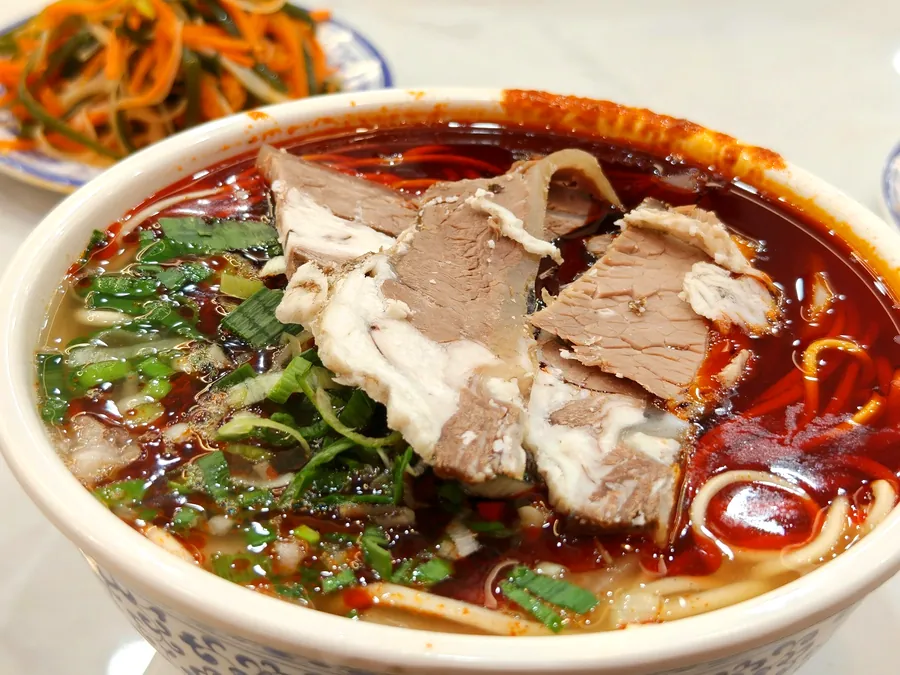
The Lanzhou canon specifies exactly: clear broth (from beef bones simmered overnight), white radish, red chili oil floating like a sunset, green cilantro and garlic sprouts — plus yellow noodles pulled to order in one of a dozen widths, from hair-thin to wide as a belt.
The dish has spread to every city in China, but the northwest versions (Lanzhou itself, and the Hui restaurants of Xi’an and Dunhuang) keep the discipline: beef brisket sliced thin, egg optional ("add egg jia dan"), and the bowl under four dollars. It is breakfast, lunch and hangover cure in one.
Order by noodle width, not by topping: the national heritage standard names five round gauges (maoxi hair-thin, xi, erxi, sanxi, erzhuzi) and three flat ones (jiuye leaf-width, kuan, dakuan), plus the triangular-edged qiaomailengzi, and a puller will make any of them to order at no extra cost. The dough is high-gluten wheat worked with "three waters, three ashes, eighty-one kneads" and a natural alkali called penghui, burned from Gobi desert weeds, which is what gives the strands their springy, slightly translucent bite. Go at opening for "tou tang" — the first, clearest broth of the day — because the stock is simmered 5 to 7 hours from Gannan beef and bone with a dozen spices and never topped up mid-service. The technique was commercialised by the Hui cook Ma Baozi (a street cart in 1915, a fixed shop in 1919) and was added to China’s fifth national intangible-heritage batch in 2021; the trade now counts more than 40,000 shops and half a million workers nationwide.
Where to eat it
- Hui-run beef-noodle shops in Xi’an and Dunhuang
- Any northwest noodle counter with a pulling board in the window
Named tables that do it well
- Tong Sheng Xiang — Local Institution
- De Fa Chang — Local Institution
- Fan Ji Roujiamo — Local Institution
- Lao Sun Jia — Local Institution
Routes that eat their way here
More dishes to know
- Big Plate Chicken (Dapanji) (大盘鸡)
- Cong You Bing (Scallion Pancake) (葱油饼)
- Zhajiang Noodles (炸酱面)
- Dan Dan Noodles (担担面)
- Chongqing Xiao Mian (重庆小面)
- Claypot Rice (煲仔饭)