
China focus
City Guide: Chengdu, China
City Guide: Chengdu, China — a China-focused city or travel guide. Read the notes, then place it in a day-by-day China route with the timing worked out.
The detail that stays
Consider the panda drill: Fly all the way to Chengdu to see irrepressibly cute and cuddly pandas. Pop in for a day to watch them wrestle and devour bamboo and generally weeble-wobble around until — if you watch long enough — they all fall down and nap. Then jet 1,000 miles due east to Beijing or one of China 's other marquee cities or cultural sites. For decades, this is how the capital of Sichuan province has factored into most tours of the country — which, it turns out, makes about as much sense as heading to Paris to check off the Eiffel Tower and skipping town without enjoying the rest of the City of Light's joie de vivre. China's westernmost megacity of roughly 14 million residents has long captured Westerners' attention with its giant panda research center. But recently, visitors are discovering what domestic Chinese tourists have known for years: Chengdu is more than a one-trick bear, so to speak, with a scorching-hot dining scene, temples and historic cultural sites, and a stylish, creative edge.
"Chengdu is very popular for its underground culture, hip-hop, art, independent fashion designers, and super-friendly LGBT community," says Kurt Macher, who moved to the city as general manager of The Temple House hotel three years ago. The 100-room outpost had opened a year earlier as part of the Sino-Ocean Taikoo Li restoration and retail development, which also created a pedestrianized district with a mall, built around restored heritage buildings such as the 1,600-year-old Daci Temple. In the brief time since his arrival, Macher has watched the neighborhood transform into the city's place to be seen. Free-spending and well-funded Chinese millennials stock up and strike poses throughout Taikoo Li mall's open-air thoroughfares, then rally for the night with DJs in Jing bar at The Temple House before moving on to hours-long hot-pot feasts and the clubs. A short walk from the hotel, the Shuijingfang Museum provides a fascinating tour of the country's oldest distillery, a vast building where visitors can watch workers create labor-intensive baijiu (a sorghum-based spirit) in pits in the same way it's been made there since 1408.
Planning the visit
Nearby, pedestrian-only Jinli Street fills with locals and travelers who come for teahouses, bars, souvenir shops, and Sichuan opera performances, in which actors demonstrate split-second "face changes" with masks and magician-like sleight of hand. Throughout its adjoining alleys, vendors hawk skewers of just about everything you can imagine (and some things you'd likely rather not), bathed in chili oil and flecked with crushed Sichuan peppercorns, famed for their mouth-numbing effect that kicks off with the sensation of a mild electric shock. "Chengdu is alive and in constant movement," Macher says. "You can leave town for two weeks and return to discover five new buildings, three new restaurants, and that you have new neighbors." In some respects, the city has always pushed boundaries. Traders in the Silk Road outpost introduced paper currency to the world in the tenth century, and it spread across the country as if they'd invented the confetti cannon. Last year its aerospace research institute announced plans to install a "fake moon" — a mirrored satellite fixed in orbit to bathe the city in soft light as a stand-in for streetlights.
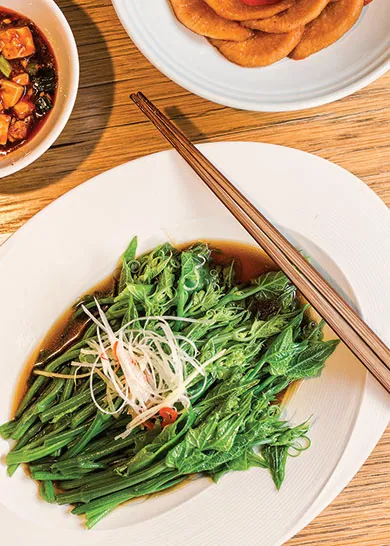
Mi Xun Teahouse: Tea culture is essential to locals, who typically outnumber Temple House guests in Mi Xun's tranquil outdoor courtyard. Its vegan and vegetarian menu wins high praise for dishes such as bamboo mushrooms with green Sichuan peppercorn sauce and a nonspicy, truffled pu'erh tea hot pot. Xiao Long Fan Da Jiang Hotpot: Temple House concierges frequently preorder meals for guests from the Chinese-language menu at this lively hot pot favorite a short walk from the hotel, and coordinate tables with good views of the face-changing opera performances. Ma Wang Zi: Across the street from the hotel, Ma Wang is one of the city's most popular restaurants for high-end Sichuan cuisine, such as eggplant with shrimp balls, spicy fish pot, and fresh corn pancakes. Jing: DJs, a laid-back all-weather terrace, a sultry interior, and creative drinks — such as Sichuan negronis and mules that impart the peppercorn's tingling sensations — draw a crowd to Jing.
The setting
Photography is usually the part people underestimate with City Guide. The useful hour is often early, before the tour groups, or late when the light drops behind the skyline. We note those windows in the itinerary and leave the middle of the day for the indoor stops, which keeps the pace comfortable in winter light without sacrificing the reason for the visit.
For travellers drawn to City Guide, the practical question is how to fit it into a wider China route without losing the day to transfers. Our planners sequence each itinerary around rail timetables and opening hours, so a morning set aside for this subject can sit beside an afternoon in a second city on the same rail corridor rather than competing with it. The month matters as well: winter light changes both the light and the crowds, and we adjust the order of stops to match.
What makes it worth the detour
The places around City Guide tend to reward a second visit more than a longer first one. Rather than stacking four stops into a single day, we pair one anchor experience with a short walk or a sitting-down meal nearby. In winter light that also means working around the busiest arrival windows at stations and galleries, something a generic day plan rarely accounts for.
In pictures
Scenes from the story
A visual companion to the notes above, kept in the same warm grade as the rest of the site.

Questions
Planning notes for City Guide: Chengdu, China
Short answers to the practical questions that come up when this subject turns into a real itinerary.
When should I plan City Guide into a China trip?
Send your dates; for City Guide we sequence stops around winter light light, rail timetables and opening hours.
How many days does City Guide need?
Usually one unhurried half day plus transfers. We write that into the day plan rather than stacking stops.
Can City Guide be combined with other cities?
Yes. We pair it with a nearby hub on the same corridor so the route keeps a logical order.
Do you confirm hotels near City Guide?
We work from verified rates and confirmed benefits, then place the stay where it shortens the daily transfers.
Keep planning
Where this fits in a China route
Related destinations, routes and reading, drawn from the site rather than from an external catalogue.
Plan the trip
We will put the days in order.
Send your dates and the places above that matter to you. The first plan comes back with timings, hotels and the transport already resolved.